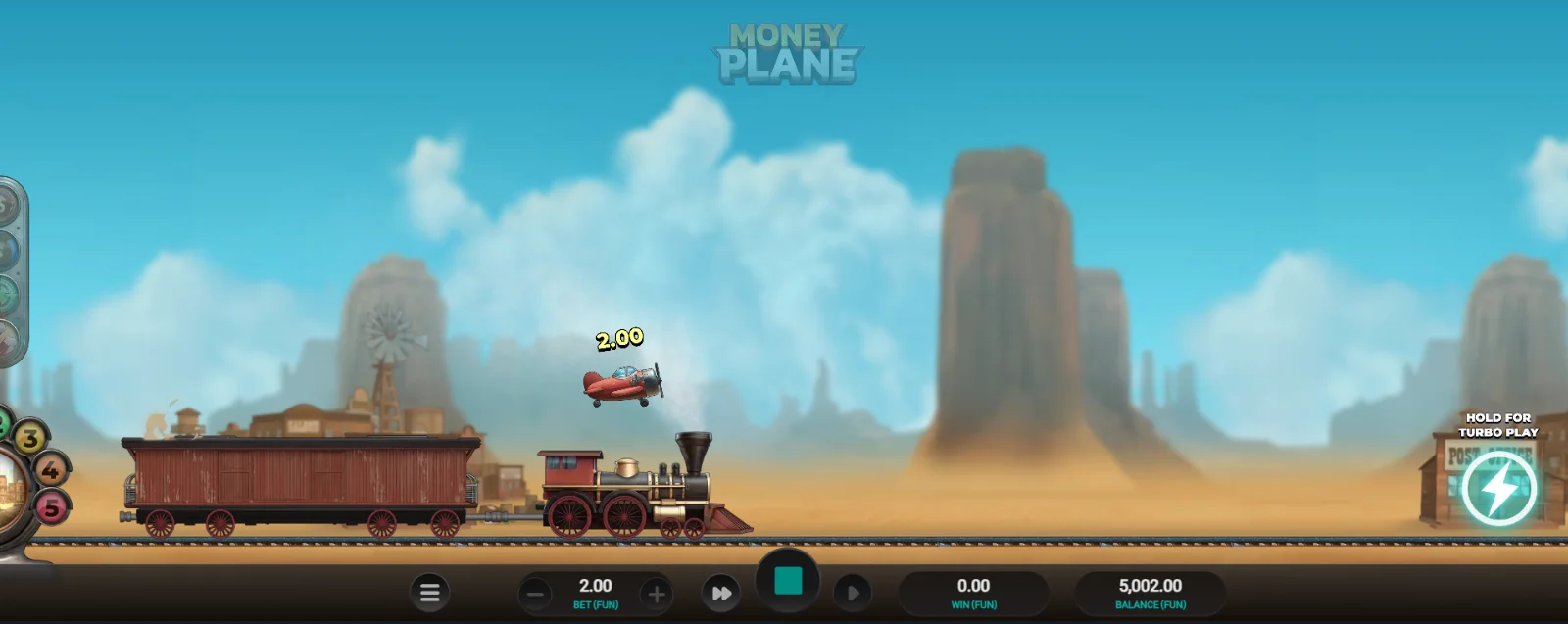
Money Plane opens every round with a countdown, and those few seconds deserve more attention than they usually get. Before the paper plane moves, the bet fields are open, nothing is at risk and every choice can still be changed.
Then the timer hits zero. The plane lifts, a multiplier begins to grow next to it, and a single question takes over: how long do you stay on board?
On the studio's side it is listed under the full name Moneyplane Bail2Win. Hacksaw Gaming had never released a crash game before this one, and it runs on the studio's own Bail2Win format, which comes down to one call: picking your bail-out point and locking in whatever multiplier is on display at that second.
Visually, Money Plane keeps things sparse. A folded sheet of paper climbs across a wide sky, rendered with smooth, streamlined lines and almost nothing else on screen. That economy is useful, because during a flight only two things really count: the figure and the exit button.
What follows traces one Money Plane flight from the first bet to its last second, then turns to the automatic tools, the published figures, access and sensible limits.
Placing a stake before take-off
All the settings belong to the countdown. You pick an amount, confirm it and wait; the moment the plane is airborne, that bet belongs to the flight.
The accepted range starts at ₱6.2 and reaches ₱6,200 on each bet, though the casino running Money Plane decides exactly where its own limits sit. Whatever minimum and maximum appear on your screen are the ones that count.
A good stake is one you would hardly miss. Rounds follow each other briskly, so an amount that looks harmless once can grow into a real sum over a few dozen flights. Splitting a session budget into equal portions before the first round usually works better than improvising each time.
Use the countdown for a quick check as well. Is a second panel open? Is an automatic setting still active from last time? Slips made here often cost more than anything decided in mid-air.
The climb and the Money Plane multiplier
Once airborne, the plane drags a multiplier upwards with it, and the figure climbs without pause until the flight ends. At any instant, that number tells you what your bet would be worth if you took it right then.
That is all there is to the engine of Money Plane. No reels spin and no feature needs unlocking. You follow a number going up and an ending that nobody can see coming.
The tension comes from that unknown end point. Nothing in the animation warns of a fall; the plane does not hesitate or lose speed first. A flight may be over almost at once or keep going well past what anyone expected.
Every Money Plane flight is random. Earlier rounds leave no trace on the next one, so a cluster of short flights never means a long one is owed, and a streak of big multipliers does not mean a quick drop is near. Tools and channels claiming to spot patterns in Money Plane history are offering something the game cannot provide.
There is, however, a hard ceiling. No bet can ever pay beyond 10,000 times its size. Keeping that cap in view puts the climb in proportion: the multiplier may grow large, but it has a limit, and nearly every real decision is made far below it.
Deciding when to bail out
This choice is the one the format is named after. Bail2Win, in Hacksaw Gaming's terms, means picking the instant to leave the flight with the multiplier currently displayed. Hit the cash-out button during the climb, and that figure is applied to your bet.
Simple on paper, harder in the moment. Leaving early secures a small but certain return. Holding on lets the possible payout swell, together with the risk of the plane falling first. No option and no routine makes that tension disappear; every Money Plane round contains it.
Some arithmetic makes it concrete. Here is an illustration and nothing more: a ₱25 bet collected at x25 pays ₱620. The sum exists to show the multiplication at work. Do not treat it as a usual outcome, and do not expect any given flight to get as far as x25.
Three habits help when the moment comes.
Settle on a target during the countdown instead of choosing while the figure is racing. Targets picked under pressure tend to creep upwards.
Accept a late exit as part of play, not as an error to fix next round. Raising the stake to win back a loss empties a budget faster than almost anything else.
Keep in mind that a bolder target is not a wiser one. It trades smaller, more frequent returns for larger, rarer ones, and no exit point alters the randomness underneath.
When the Money Plane crashes
Every flight ends sooner or later. The plane tips out of the sky, the counter stops and the round closes.
Anyone who had already left keeps the return fixed at their chosen figure; the fall changes nothing for them. Anyone still aboard loses the whole stake placed on that flight. Nothing is refunded in part, and the same round offers no second go.
This is the plain truth behind Money Plane. However high the counter had gone and however close you were to clicking, a fall before your exit takes the entire bet.
It also explains why crash games can feel so intense. A promising climb can vanish in a blink, and wanting to dive straight back in with more is a common reaction. Sitting out a countdown or two is usually the better reset.
A new countdown then starts, and the coming flight inherits nothing from the previous one.
Other players in the same flight
Money Plane is not played alone. All participants in a round share one flight, which means the plane you watch is the very same plane the rest of the field is watching.
That creates a collective tempo: timers run together, the take-off is common and the round finishes for all at one moment. Your choices stay yours, though. You set the bet, you choose the exit, and your result rests on those decisions and on when the flight ends.
It is tempting to copy what a busy round seems to be doing. Imitating others is not a plan. Nobody else knows where the crash will come, and their budgets and appetite for risk may differ completely from yours.
Treat the shared flight as atmosphere, not as a clue, and stick to the plan you made before the timer ran out.
Extra bet panels in Money Plane
A single flight can carry several bet panels in parallel, and each holds a stake of its own.
A typical use is to split the decision: one panel aims for a quick, cautious exit, another waits for a higher figure. Both ride the same plane and face the same fall, yet each can be collected at its own moment.
The attraction is clear, and so is the price. Every added panel is another bet. Running several of them multiplies what you might win and what you might lose on each flight, and if the plane falls before any exit, all open panels lose together.
So extra panels are first a budget matter and only then a tactical one. A session sized for one bet per round can run dry several times faster with more panels in play.
Before each take-off, add up the amount riding across every open panel. If that sum would feel uncomfortable for one round, it is too large for a full session.
Setting the Money Plane exit in advance
Beside the manual buttons sit two automated features. Auto Cash Out and Autoplay allow you to fix bet amounts and exit multipliers ahead of time, so play follows a plan drawn up before the flight.
Auto Cash Out is the more immediate one. You choose a figure; if the plane gets there, the bet is collected automatically. If it falls short, the stake goes, just as with a manual bet. Hesitation disappears, risk does not.
Autoplay handles the betting side, repeating bets over successive rounds with values chosen in advance. Used together, they can make a session calmer, since the exit is chosen without the pressure of a climb.
Some caution is wise. Automatic play speeds rounds up, which can hide how much has gone out. Values saved during an earlier visit may still be switched on, and an overly ambitious exit figure will simply be missed more often.
Check the stake, the exit figure and the number of panels before activating either feature, and watch your balance rather than leaving the game running by itself.
Hacksaw Gaming and its first crash title
Hacksaw Gaming first presented Moneyplane Bail2Win on 7 September 2026, then released it later in September. Before Moneyplane, no crash game had carried the studio's name, while Bail2Win names the format Hacksaw designed for it.
For anyone playing, the studio and the casino play very different roles. Hacksaw Gaming develops Money Plane and licenses it out to online operators. The casino takes care of your account, deposits, withdrawals and identity verification, sets the bet limits within the game's range and picks the RTP version.
That division is why Money Plane can differ slightly from one lobby to the next. The plane, the counter and the exit mechanic do not change, but the bet limits and the return figure depend on the operator.
It also means the studio does not hand the game out as a standalone app. Money Plane lives inside licensed casino lobbies, generally among instant or crash games, and any download or "modified version" offered elsewhere has nothing to do with Hacksaw Gaming.
Money Plane numbers
Only a handful of figures are published for the game, and each is worth having in mind.
- Origin: the debut crash release by Hacksaw Gaming, running on the Bail2Win format the studio devised.
- Dates: first presented on 7 September 2026; release came later in September.
- Top payout: 10,000 times the bet at most, whatever the counter shows.
- RTP: five configurations sit between 91.9% and 98%, and every operator selects one of them, and the help section of whichever version loads lists the figure in force. Two casinos running Money Plane may therefore show different returns.
- Bet range: as little as ₱6.2 and as much as ₱6,200 per bet, subject to each casino's settings.
- Volatility: covered in the game's own help section rather than in any published rating.
- Shared rounds: one flight serves every player who joins it.
- Bet panels: several may be opened on one flight, each holding its own bet.
- Automation: bet amounts and exit figures can be fixed beforehand through Autoplay and the Auto Cash Out tool.
- Technology: built in HTML5 for desktop and mobile browsers, nothing to install.
- Age: real-money play is open to players aged 18 and up only.
That RTP entry is worth reading twice. With five versions in circulation, a percentage printed on some other page may not match the one in front of you. The in-game help is the only dependable source.
RTP is also a long-term average, worked out over a vast quantity of rounds. It is no forecast for one session, and short spells of Money Plane can drift far from it in either direction.
Practising for free
A free demo of Money Plane is offered on many casino sites. Flights, counter and buttons behave the same, but the balance is virtual and nothing real is bet or won.
A demo is the easiest way to feel the speed of the rounds, try a second panel and see Auto Cash Out in action without spending anything.
Ce jeu révèle aussi vos propres réflexes. Si vous vous surprenez à augmenter les mises après chaque chute, ou à viser plus haut à chaque fois, la démo le montre en toute sécurité.
Tous les casinos ne l'offrent pas, alors regardez sur la vignette du jeu dans le hall. Les résultats de la démo ne prédisent rien concernant les parties d'argent réel, qui restent aléatoires.
Navigateurs, téléphones et tablettes
Money Plane est un titre HTML5 qui se charge directement dans les navigateurs de bureau et mobiles. Rien n’a besoin d'être installé, donc tout fichier vendu comme une "application officielle" pour le jeu mérite de la méfiance.
Sur un téléphone, le même vol Money Plane se déroule dans le navigateur. Un petit écran laisse peu de marge, alors vérifiez la mise avant chaque décollage.
Les sorties dépendent du timing, ce qui rend une connexion stable plus importante que dans les jeux plus lents. Un signal faible ou le fait de sauter entre les applications en plein vol rend une réaction tardive plus probable.
Casinos licenciés et règles d'âge
Money Plane avec de vraies mises n'est proposé que par des casinos en ligne licenciés ayant des titres Hacksaw Gaming dans leur catalogue, et seulement aux adultes ; l'âge minimum est de 18 ans.
Avant de vous inscrire, vérifiez que l'opérateur affiche une licence valide, qu'il accepte des clients dans votre pays et quelles limites de mise il fixe sur Money Plane. Avec un bonus, lisez attentivement les conditions : seul l'opérateur définit combien de temps de jeu de crash compte pour le playthrough, quels titres sont exclus et quelle est la plus grande mise unique tolérée pendant que l'offre est active.
Le chemin vers le jeu d'argent réel est simple : inscrivez-vous, complétez les vérifications d'identité, déposez, puis ouvrez le jeu depuis la section immédiate ou de crash. Les sites non licenciés qui sautent la vérification ne sont pas un raccourci ; ils mettent à risque à la fois les fonds et les données personnelles.
Rendre Money Plane amusant
Des tours rapides et des résultats immédiats rendent les jeux de crash légers, c’est précisément pourquoi ils nécessitent des limites. Une session de Money Plane peut durer beaucoup plus longtemps que prévu.
Fixez un budget avant de commencer et considérez-le comme le coût du divertissement, pas un pot à faire croître. Choisissez aussi une durée de session, et arrêtez-vous lorsque l'une ou l'autre limite est atteinte, peu importe les vols récents.
Les pauses sont importantes. Quelques minutes loin après une longue session, gagner ou perdre, vous aide à voir où en sont les choses.
Activez les plafonds de dépôt et les rappels de temps de jeu que votre opérateur propose ; ils maintiennent un plan en place lorsque l'enthousiasme l'emporte. L'auto-exclusion est disponible pour des pauses plus longues.
Ne faites pas confiance à tout ce qui prétend prédire le crash. Les prédicteurs, bots, groupes de signaux et fichiers modifiés ne peuvent pas lire un résultat aléatoire à l'avance, et certains existent uniquement pour récolter de l'argent ou des détails personnels.
Lorsque le jeu ne semble plus agréable, ou commence à peser sur l'argent, le temps ou les relations, recherchez un service d'aide professionnelle géré spécifiquement pour cela, et faites-le le plus tôt possible. Un appel précoce est toujours plus simple qu'un tardif.
Notes avant le premier vol réel
| Point | Ce que cela signifie pour vous |
|---|---|
| Chute avant votre sortie | La mise complète sur ce vol est perdue |
| Version RTP | Cinq versions entre 91.9% et 98%; l'aide en jeu montre la vôtre |
| Plafond de paiement | Rien au-dessus de 10,000 fois la mise |
| Limites de mise | Chaque casino fonctionne avec des mises entre ₱6.2 et ₱6,200 par mise |
| Panneaux de mise supplémentaires | Chaque panneau ajouté augmente ce qui peut être gagné et ce qui peut être perdu |
| Fonctionnalités automatisées | Autoplay plus l'outil Auto Cash Out appliquent les valeurs que vous définissez |
| Aléatoire | Rien ne peut vous dire quand l'avion va tomber |
| Où jouer | Casinos licenciés uniquement, pour les joueurs de 18 ans et plus |
| Jeu gratuit | De nombreux sites de casino offrent une démo pour s'entraîner |